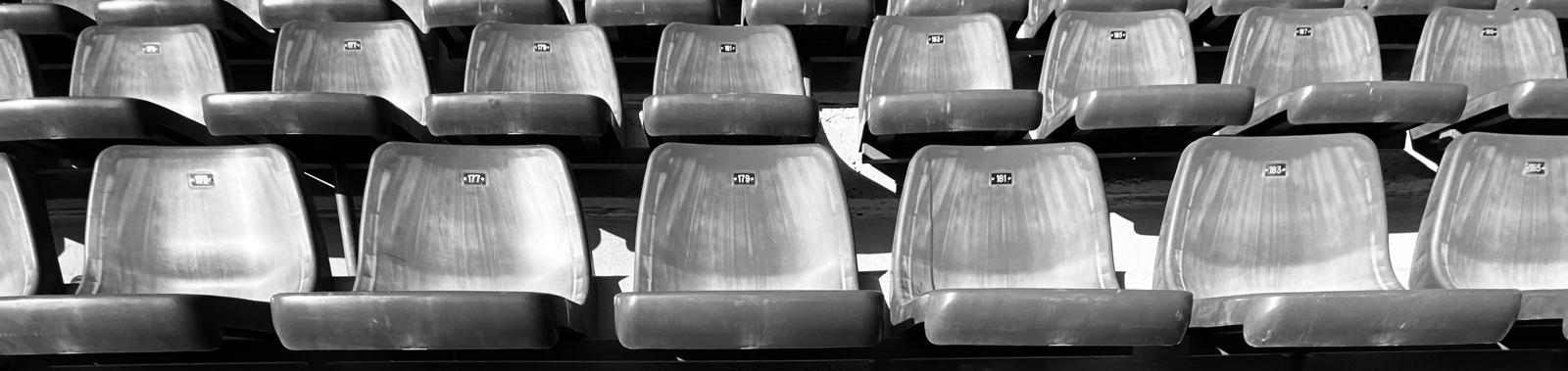
For almost a hundred years, Milan had the same answer whenever San Siro became outdated. Build more of it. A second tier rose above the first. New ramps carried bigger crowds higher into the stadium. For the 1990 World Cup, another ring, concrete towers and a vast red roof were added. Each generation inherited a San Siro that no longer quite worked and built a new version around it. Now, for the first time, that answer is changing.
San Siro, officially the Stadio Giuseppe Meazza, turns one hundred in 2026 while Milan and Inter prepare to build a new stadium beside it. The old ground survived this long not because the city preserved it, but because the city kept rebuilding it. To understand why Milan may finally stop, you have to go back to the much smaller stadium that opened here in 1926.
1926 A new ground for a modern city
The San Siro that opened in 1926 would be difficult to recognise today. Four separate stands surrounded the pitch, with open space beyond them and room for around 35,000 spectators. Milan president Piero Pirelli wanted a stadium built specifically for football. One inspired by the English grounds he admired and without an athletics track separating the crowd from the game.

San Siro belonged to a city that was already learning to think in bigger terms. Milan had become one of Italy’s great industrial centres, shaped by companies such as Pirelli, Breda, Edison and Alfa Romeo. Factories, engineering and new infrastructure were changing the city. This drew thousands of people to the city in search of work. A modern football ground fitted naturally into that world. It was another piece of a city that believed growth could be built.
The racecourses next door were still part of the landscape. The spaces beneath the stands were even used for horses, hay and feed. The opening was far removed from the monument San Siro would later become. On 19 September 1926, Milan opened San Siro against Inter. Giuseppe Santagostino scored the first goal ever seen there, but Inter won 6–3. It was a fitting beginning for a stadium built for one club that would eventually become home to both.
1935 Football outgrew San Siro
San Siro was not even ten years old when it already needed to grow. In 1934, around 35,000 people watched Italy beat Austria here in a World Cup semi final. The ground Piero Pirelli had built for Milan was already being used for bigger events. A year later, the City of Milan bought the stadium.
Football was becoming a mass phenomenon in 1930s Italy. Under Mussolini’s fascist regime, the game was also increasingly used as a tool for national propaganda and public support. Milan was growing quickly at the same time. By 1931 the city had almost one million inhabitants, fuelled by people moving there for work. San Siro was therefore changing in a city where both the population and the importance of football were becoming much larger than they had been when the stadium opened.
San Siro had to follow that growth. Work on a major expansion began in 1938, and by the following year the stadium could hold around 55,000 people. On 13 May 1939, Italy played England there in front of the enlarged stands. Giuseppe Meazza faced a side that included Stanley Matthews, and the match finished 2–2.
Thirteen years after Milan opened a new club ground on the edge of the city, San Siro grew to be a stage large enough the biggest events.
1955 A stadium for two clubs
20 years later, it was no longer Milan’s stadium alone. Inter began playing its home matches there in 1947. Within a few years both clubs were competing at the top of Italian football. Milan won the league in 1951 and again in 1955, while Inter were champions in 1953 and 1954. The ground built for one club was now serving two of the biggest teams in the country.
At the same time, Milan was becoming much busier. During the 1950s, hundreds of thousands of people moved to the city, many in search of work. By the end of the decade traffic had become so intense that around 250,000 daily visits were estimated in Milan. The city around San Siro was growing faster, denser and harder to move through.

In 1955 the stadium grew upwards. A new second ring was built above the existing stands and the capacity rose to around 85,000. The huge ramps around the outside were part of the solution for moving those crowds towards the new upper level. San Siro was becoming the stadium we can begin to recognise today, but its size was still a response to something simple. More people wanted to be inside it.
The bigger stadium also belonged to a different football culture. Milan and Inter were now bringing their own crowds into the same ground week after week. The concrete stayed the same, but the colours, banners and noise changed with the home side. San Siro had become a stadium shared by two rivals, and its identity was increasingly something the crowd created rather than something fixed to the building itself.
By the middle of the 1950s, San Siro had become much larger than the football ground Milan opened thirty years earlier. The city had grown, another club had moved in and the stadium had risen above its original form to make room for them.
1990 San Siro becomes an icon
For more than thirty years, the basic shape of San Siro remained recognisable. Then Italy won the right to host the 1990 World Cup. Milan faced the same question as before. The stadium was ageing, and replacement was considered. Instead time and financial limits pushed the project towards a familiar solution. Build on what was already there.
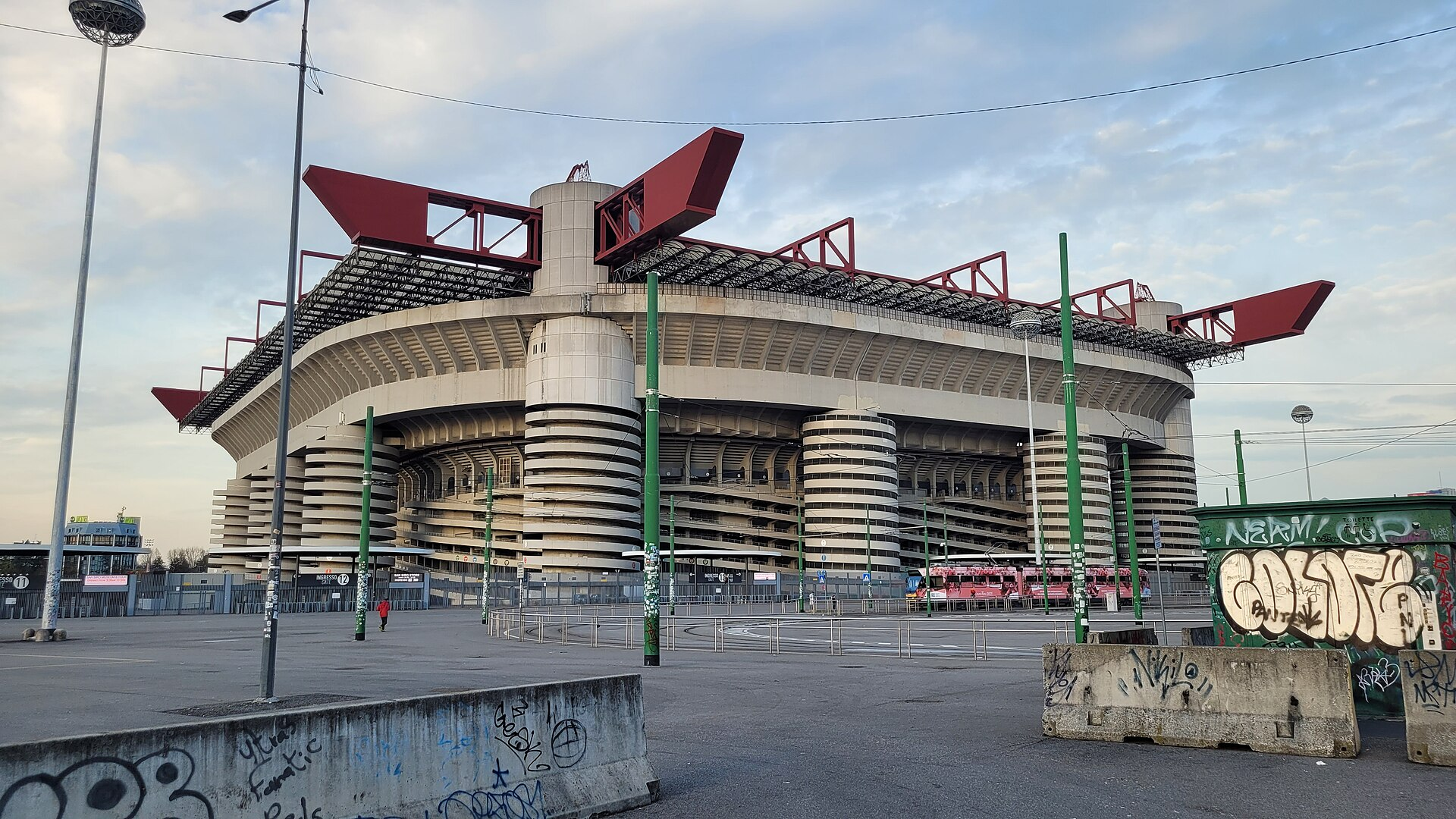
This renovation was the most significant. A third tier rose above the existing stadium, supported by eleven concrete towers. Four of those towers carried the enormous roof and its red steel beams. The result did more than add seats. It gave San Siro the outline most football supporters around the world would later recognise immediately.

Milan had changed just as much since San Siro’s last great expansion. By the 1980s the city was presenting a new version of itself. Advertising, television, fashion and a new culture of consumption helped shape the image of Milano da bere, a confident and increasingly glamorous Milan that wanted to be seen. The city around San Siro was no longer the industrial Milan of the 1950s.
Inside the stadium, Milan was becoming just as ambitious as the city around it. In 1986, former president and media tycoon Silvio Berlusconi bought AC Milan. He began rebuilding the club into a European powerhouse. Arrigo Sacchi arrived as coach a year later. With Gullit, Van Basten and Rijkaard at the heart of the team, Milan won the European Cup in 1989 and again in 1990. The rebuilt San Siro appeared at the same moment that one of its clubs was becoming a symbol of European football far beyond Italy.
2026 When renovation is no longer enough
For a century, every problem at San Siro had produced roughly the same response. Expand it, modernise it or build another layer around what was already there. In 2026, Milan and Inter are doing something fundamentally different. The clubs now own San Siro and the surrounding area, but instead of rebuilding the old stadium again, they are preparing to build a new one beside it.
The problem is no longer simply how many people San Siro can hold. Inter president Giuseppe Marotta has argued that the stadium leaves Milan and Inter far behind Europe’s richest clubs in matchday income. He pointed to hospitality and premium spaces to fill the gap. It is a shift we have seen elsewhere too. At AT&T Stadium in Texas, premium clubs, lounges and private suites are built into the economics of the stadium rather than added as an extra. San Siro comes from a different age. For most of its history, making the stadium bigger meant finding room for more people. Today, clubs are increasingly concerned with how much a stadium can offer and earn once those people are inside.
The new plan does not simply replace San Siro overnight. Milan and Inter intend to build the new stadium first. Only after that will part of the existing Meazza be demolished, while another section is kept and given a new use. The city has already started the formal planning process, with construction currently intended to begin in the second half of 2027.

There is a final irony in the concrete added in 1955. Seventy years later, that second tier became part of the debate over whether San Siro should receive cultural protection. In the Italian Senate, the culture minister said the official completion document for the ring was dated 10 November 1955, making that date relevant to any formal heritage assessment. A part of the stadium once built to make San Siro modern had survived long enough to become something people were trying to preserve.
One stadium, many Milans
San Siro reaches its hundredth year with very little of the stadium from 1926 still visible. Yet that may be exactly why it lasted so long. Milan never treated the ground as something finished. Each generation changed it to fit a different city, a different crowd and a different idea of what football needed.
The first stands belonged to an industrial Milan. The second ring rose with a city filling with new people and two clubs sharing the same home. The third ring and roof arrived when Milan wanted to look outward and its football was conquering Europe.
Now the city is changing San Siro again, only this time the next version will not be built over the old one.
For a century, San Siro survived because Milan kept adapting it. This time, the city is not adapting San Siro. It is preparing to leave it behind.