AT&T Stadium was built to be seen. The glass walls, the roof, the huge screen above the field and the size of the stands all make the same point. It is the home of the Dallas Cowboys, built for American football and for the kind of event that continues even when the ball is not moving. In 2026, this building has to do something different. For a few weeks, AT&T Stadium will step into the world of international football. The stadium will still stand in Arlington. The crowd will still enter through the same doors. But inside, the building has to follow another set of rules.
That change is where this story begins. To understand why AT&T Stadium has to adapt, we first have to understand the American football world that built it.
The Cowboys before AT&T Stadium
AT&T Stadium did not make Dallas an American football place. The habit was already there. Long before the Cowboys played in Arlington, football had a firm place in Texas life. High school games mattered. College games filled large venues. At the Cotton Bowl, crowds came to watch SMU, Texas, Oklahoma and TCU. In 1952, the Dallas Texans tried to make the NFL work in the city. They played at the Cotton Bowl, but the team collapsed during its first season. Dallas had shown love for football.
In 1960, the Dallas Cowboys entered the NFL as a new team, during a fight for control over professional football in America. The established NFL wanted to grow, while a new rival league was trying to break in. The Cowboys did not become powerful at once. They first needed a clear identity. Tom Landry, their first head coach, gave the team a steady face on the sidelines. Behind him, Tex Schramm helped turn the club into a modern sports organisation, while Gil Brandt worked on scouting players in a more systematic way. Together, they helped build a team that slowly became familiar across America.
From 1966 to 1985, Landry’s team recorded 20 consecutive winning seasons. Television carried the white helmets and blue star across the country. NFL Films later gave the Cowboys the nickname America’s Team. It was a media phrase, but it stuck because the team was already visible far beyond North Texas. Texas Stadium gave that image a home. The Cowboys moved there in 1971. The new stadium stood in Irving, outside central Dallas, with over 65,000 seats. It cost $35 million and was funded through fan bonds. That made supporters part of the building before they ever reached their seats.

Texas Stadium in Irving gave the Dallas Cowboys their first modern stage before AT&T Stadium carried that identity into a larger era.
Texas Stadium became more than a Cowboys venue. It hosted concerts, college games, high school games, commercials and public events. It appeared in the opening credits of Dallas, the television series that carried the city’s image around the world. Over 700 high school games were played here, linking the professional stage back to the wider football habit of Texas. By the time AT&T Stadium opened, the Cowboys already had a culture, a brand and a statewide memory behind them.
The modern NFL stadium
A typical modern NFL stadium starts with a field that looks simple. The playing area is 100 yards long (91 metres) with two 10 yard (9 metres) end zones. The field is about 53 yards (49 metres) wide. Around that compact shape sits a much larger building. It is made for a sport that stops and resets. Timeouts, replays, substitutions and commercial breaks are all part of it. That changes the way the stadium works. The screen matters. The sound matters. The pauses between plays matter. Supporters do not only watch the field. They also watch the production around it. It is a stadium built for the crowd, but also for the camera.
That typical NFL stadium is also shaped by money and movement. Ordinary seats still matter, but the most valuable spaces are often suites and premium areas. NFL revenue rules help explain why. Teams share part of normal ticket revenue, but they can keep more of the money from suites and premium spaces. That is why modern stadiums are built with many layers of access. Some fans sit in regular seats. Others enter clubs, lounges and private boxes. Outside the stadium, parking lots carry another part of the culture. Fans gather early and turn the space around the building into part of matchday. The stadium is also built for concerts, college football, corporate events and other major shows. Modern American stadiums are event venues, not only sports stadiums. That matters for this story, because the Cowboys’ new home would take this model further.
The Cowboys model
AT&T Stadium is what that modern NFL logic looks like when it is built for the Dallas Cowboys. It opened in Arlington in 2009 as the successor to Texas Stadium, but it did not start again from nothing. The old stadium in Irving had already carried the Cowboys image for decades. It had the open roof, the Ring of Honor and the memory of a team that had become visible across America. HKS took those familiar parts and placed them inside a much larger building. The roof still opens. The Ring of Honor still sits inside the bowl. The Cowboys moved stadiums, but they did not move into a neutral space. They moved into a building designed to keep their image around the field.


That image is carried by scale. AT&T Stadium spreads across a huge site and holds a crowd that can grow far beyond a normal matchday capacity. But the size is not only there to fit more people. It creates different ways to experience the same event. Some supporters watch from regular seats. Others move through clubs, lounges and private suites. The stadium has hundreds of suites and thousands of club seats. The field remains the centre of the day, but the building around it becomes part of what people have paid to enter.
This is where AT&T Stadium becomes more than a Cowboys home. It works like a production space. The glass walls, end zone plazas, operable roof, large screen and premium areas all support a matchday that continues when the ball is not moving. The same building can also change use. It has hosted the Super Bowl, the NBA All Star Game, the CONCACAF Gold Cup and major concerts. The field can become an event floor. The end zones can become hospitality spaces. That flexibility is useful, but it also reveals the stadium’s identity. It is built as a modern American event venue, not only as a sports stadium. That is why its World Cup transformation matters. Before it can serve world football, it has to loosen the logic it was built to perfect.
A World Cup in NFL venues
The United States can host the World Cup at a huge scale because the stadiums are already there. Its 11 host venues are all current NFL stadiums. They have large capacities, media space, security systems, hospitality areas and experience with major events. For FIFA, that gives the tournament a ready made stage. It also creates the central problem. These buildings were not mainly built for world football. They were built for American football, with a narrower field, different sightlines, different surfaces and a different event rhythm.
The World Cup demands changes from these stadiums. Several venues have to replace artificial turf with natural grass. Some need extra work around the lower bowl to fit a wider football pitch. Others need new lighting, clean sponsor zones and broadcast spaces. At MetLife Stadium, the grass project involves new layers below the surface. At NRG Stadium in Houston, grass has to be moved, cooled, lit and maintained inside a building made for another sport. Across the country, NFL stadiums are being asked to become football stadiums for a few weeks. AT&T Stadium is one of the clearest examples.
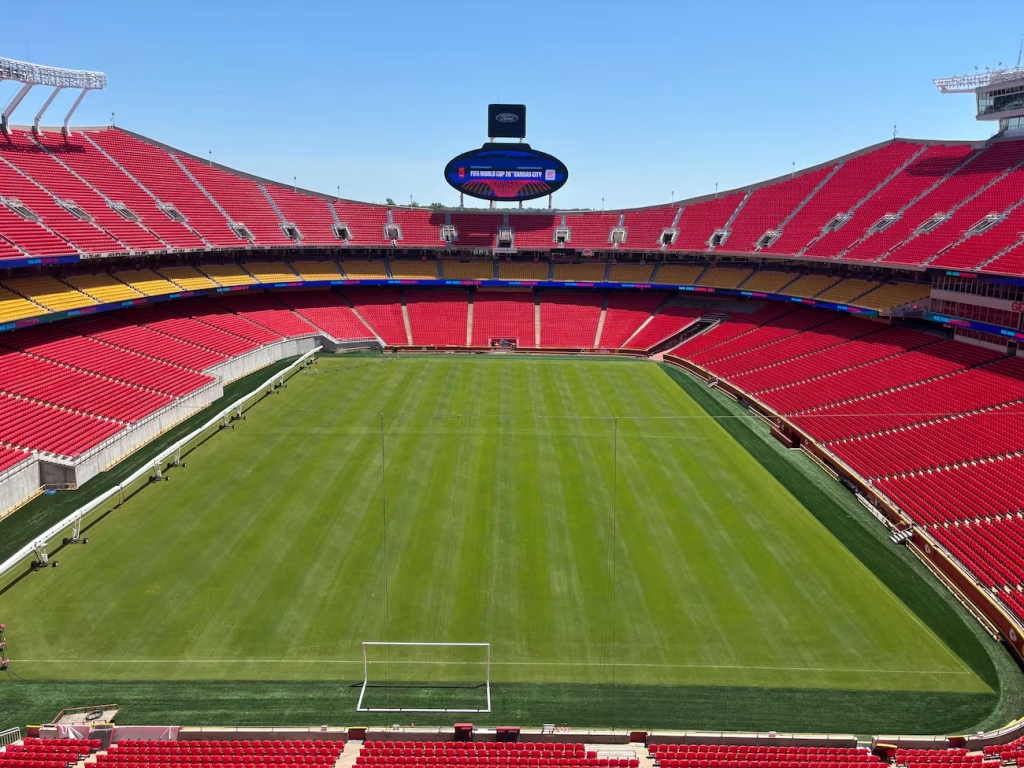
Arrowhead Stadium shows the same challenge facing several NFL venues. To fit a wider football pitch, parts of the lower stands have to make room.
AT&T stadium changes shape
In Arlington, the World Cup first changes the name. AT&T Stadium becomes Dallas Stadium. The sponsor name disappears, just as MetLife becomes New York New Jersey Stadium and NRG Stadium becomes Houston Stadium. For a few weeks, FIFA controls how the building is presented to the world. From there the changes move inside. The artificial Matrix Turf has to go. In its place comes Kentucky bluegrass, harvested in Colorado and shipped to North Texas in refrigerated trucks. It is not simply rolled onto the stadium floor. The pitch sits on drain mats, gravel, USGA grade sand, irrigation and sod. Under the grass, a sub air system moves air through the surface. A stadium built around artificial control has to support a living field.
The harder problem is not length but width. Football demands a wider pitch. That extra space reaches into the lower parts of the stadium. The field has to be raised. Parts of the seating bowl have to change. Multiple field level suites in all four corners are temporarily removed. These are not empty rooms. They are premium spaces leased to Cowboys suite holders. For the World Cup, one of the stadium’s most valuable NFL features has to make room for the pitch.
Even the roof gets a new task. Large LED grow lights from Netherlands based SGL System are connected to the stadium’s roof system, so they can be lowered over the grass and raised again when needed. The roof that usually helps control the event now helps keep the surface alive. Around the stadium, the same shift happens in other ways. The building has to serve broadcast, media, security and tournament operations. By the time the first match begins, most of the work should be invisible. That is the point. AT&T Stadium has to feel like a football venue, even though the building underneath was made for another game.
When the World Cup arrives, AT&T Stadium will still look familiar from the outside. Built from the habits of American football. It was made for pauses, screens, premium spaces, large crowds and controlled events. The World Cup does not erase that identity. It asks the stadium to bend it for a while. For a few weeks, the field becomes wider. The surface becomes natural. The name changes. Spaces built for NFL comfort give way to the needs of another game. The building does not stop being the home of the Dallas Cowboys. It simply shows how far a modern stadium can stretch.
AT&T Stadium was built to be seen. In 2026 it will be seen differently. Not only as a symbol of the Cowboys, or as one of the great American event venues, but as a place where two football worlds briefly meet on the same stands.