
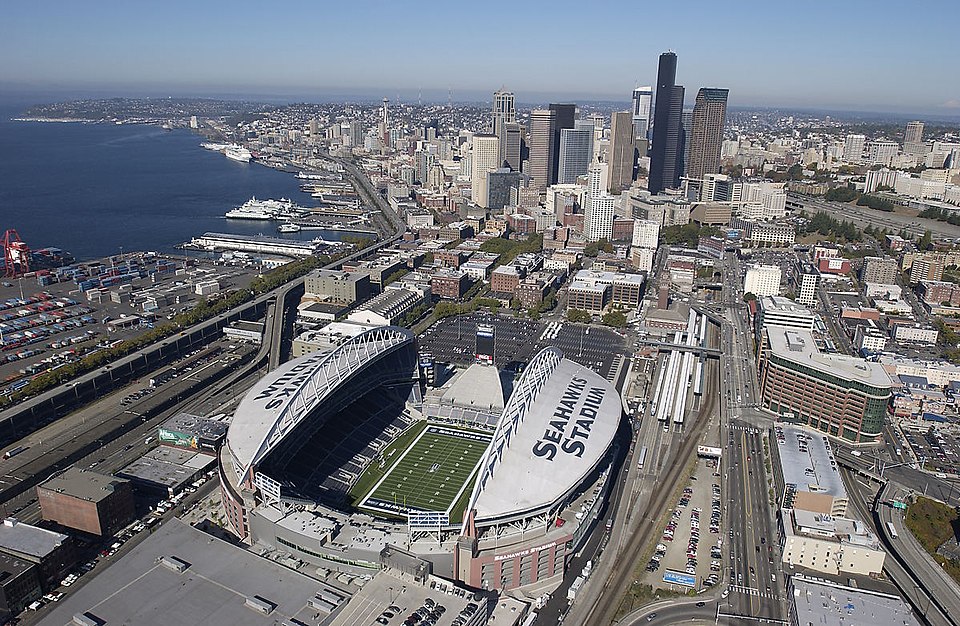
Lumen Field is one of the loudest stadiums in the world. That does not come from one moment alone. It comes from the building and the people inside it. It has held official noise records, shaken nearby seismic equipment and built a reputation that reaches beyond the NFL. The question is not only how loud Lumen Field can be. The better question is why it gets that loud.
Lumen Field in Seattle
Lumen Field stands just south of downtown Seattle. It is close to Pioneer Square, SoDo, Chinatown International District, the rail lines and the waterfront. This is not a stadium at the edge of a city. It sits where different parts of Seattle meet.
To the north is Pioneer Square, the oldest part of the city. Its brick buildings and narrow streets carry the shape of old Seattle. To the south is SoDo, shaped by industry and rail yards. The name itself once pointed back to the stadium district. It meant south of the dome, a reference to the Kingdome.
Before Lumen Field, that dome defined the site. The Kingdome opened in 1976 as a large multipurpose stadium for Seattle. It hosted the Seahawks, the Mariners and many other events. It also brought crowds, traffic and pressure to the streets around Pioneer Square and Chinatown International District. For local residents and business owners, the stadium was never only a place for sport. It also changed how the neighbourhood moved.

The Kingdome was demolished in 2000. Two years later, Lumen Field opened on the same stadium ground. The new building inherited more than a location. It inherited the routes people already knew. Supporters still arrive through the city by light rail, train, bus and on foot. They pass bars, old brick streets, station platforms and parking lots before they reach the stands. The noise comes later, but the gathering begins outside.
One of the loudest stadiums in the world
Lumen Field is not loud only because people in Seattle say it is. Its noise has been measured. In 2013, when the stadium was still called CenturyLink Field, Seahawks fans twice set a Guinness World Records mark for the loudest crowd roar at a sports stadium.
The first record came against the San Francisco 49ers in September 2013. The crowd reached 136.6 decibels. That was enough to beat the previous record held by Galatasaray fans in Istanbul. A few weeks later, Kansas City took the title at Arrowhead Stadium. Seattle then took it back in December, during a Monday night game against the New Orleans Saints. This time, the sound reached 137.6 decibels.

That record no longer stands. Arrowhead Stadium later reached 142.2 decibels and became the current Guinness record holder. Lumen Field should not be called the loudest stadium in the world today. But it can still be called one of the loudest stadiums ever measured. Its place in that conversation is based on official records, not only on reputation.
There is another reason the stadium became known for noise. In January 2011, Marshawn Lynch ran 67 yards for a touchdown against the Saints. The crowd reaction became known as the Beast Quake. A nearby seismic station recorded movement from the crowd. It was not a decibel record, but at Lumen Field, the stands could be heard, felt and measured.
Why Lumen Field is so loud
The sound at Lumen Field starts with people. But the building decides where that sound goes. The stadium was designed by Ellerbe Becket with Seattle based LMN Architects. It opened as an open air stadium, not as a dome. Still, it does not let noise escape as easily as many outdoor stadiums.
The main reason is the roof. Lumen Field has two large roof canopies above the stands. They protect about 70 percent of the seats from rain. They also give sound a hard surface to hit. When supporters shout, the noise does not simply rise into the sky. Part of it comes back toward the field.

The shape of the stands matters too. Lumen Field was built on a tight urban site, many seats sit close to the field. The lower level uses concrete, with steel framing above. These materials help reflect the sound. The stadium remains open to the air, but the bowl, roof and hard surfaces keep much of the noise near the playing area.
That makes Lumen Field different from the Kingdome. The old stadium held sound because it was fully enclosed by concrete. Lumen Field works in another way. It keeps the sky open, but places thousands of supporters under long steel roofs. The result was not planned in every detail. One architect later described part of the canopy effect as a happy accident. But the outcome is clear. The building gives the crowd a place where its noise can stay close.
The Seahawks and the 12s
The roof can hold sound, but the 12s learned how to fill it. In Seattle, the number 12 belongs to the supporters. The Seahawks retired it in 1984 as a tribute to the fans. It turned the crowd into part of the team’s identity, beside the 11 players on the field.
That identity became a stadium ritual in 2003, when the 12 Flag was raised before a home game for the first time. Since then, someone connected to the club, the city or the community raises the flag before kickoff. It is a simple act, but it tells the crowd what role it is expected to play. The noise is not background. It is part of the match.

Sometimes, that noise becomes visible in the game itself. In 2005, the New York Giants committed 11 false starts at Lumen Field. In 2023, the Carolina Panthers committed eight. Players and coaches later pointed to the same problem. The visiting offense could not hear clearly. Snap counts became harder. Timing broke down before the ball was even played.
The Sounders and another kind of noise
Lumen Field did not stay an NFL sound story. In 2009, Seattle Sounders FC began MLS play in the same stadium. Their first home match drew 32,523 people. Fans raised green scarves before kickoff. The building already had a noise reputation, but soccer brought another rhythm into the stands.
That rhythm was easy to mock from the outside. One old online clip of Sounders supporters chanting Come on Seattle. Fight and win became a meme. But the way the clip travelled is clear. It was used to laugh at American soccer culture, as if one awkward chant could explain a whole stadium.
Inside Lumen Field, the picture was different. The Sounders made large soccer crowds normal in Seattle. By 2015, the club averaged 44,245 fans per league match. In 2019, 69,274 people watched the Sounders win MLS Cup at home. In 2022, 68,741 came to the Concacaf Champions League final against Pumas UNAM. That was the largest standalone crowd in the history of that competition.
The sound was not only visible in scarves, songs and flags. It was measured too. During the 2019 MLS Cup, the Pacific Northwest Seismic Network recorded goal reactions and synchronized jumping from Sounders fans. In the 2022 Concacaf final, three Sounders goals produced recorded RaveQuakes. The Seahawks gave Lumen Field its loudest reputation. The Sounders gave the same building another football voice.
In 2026, the world will come back to this question in a different way. Lumen Field will become Seattle Stadium for the World Cup. The pitch will change. The name will change. New supporters will enter through the same gates. Many will arrive knowing it as an NFL stadium. Others will know it through the Sounders. All of them will step into a building where sound has already become part of the story.
That is what makes Lumen Field different. It is not loud because of one roof, one record or one fanbase. The roof holds the sound. The stands keep people close. The 12s made noise part of Seahawks identity. The Sounders added songs, scarves and another football rhythm. Together, they turned an open air stadium in Seattle into one of the loudest places in sport.