In 2026, supporters will walk into Houston Stadium for the World Cup. Many will come for football, flags and the feeling of a global tournament. But beside the modern stadium stands the Astrodome, the building that took in thousands of people after Hurricane Katrina flooded New Orleans in 2005. This is the story of one stadium site in Houston, where sport, shelter and memory still share the same ground.
Houston Stadium Today
Houston Stadium is not the name most people in Houston grew up using. The building opened in 2002 as Reliant Stadium. In 2014, it became NRG Stadium. For the 2026 World Cup, FIFA calls it Houston Stadium. That temporary name removes the corporate layer and makes the city the focus. It also matters because the name points beyond the building itself.
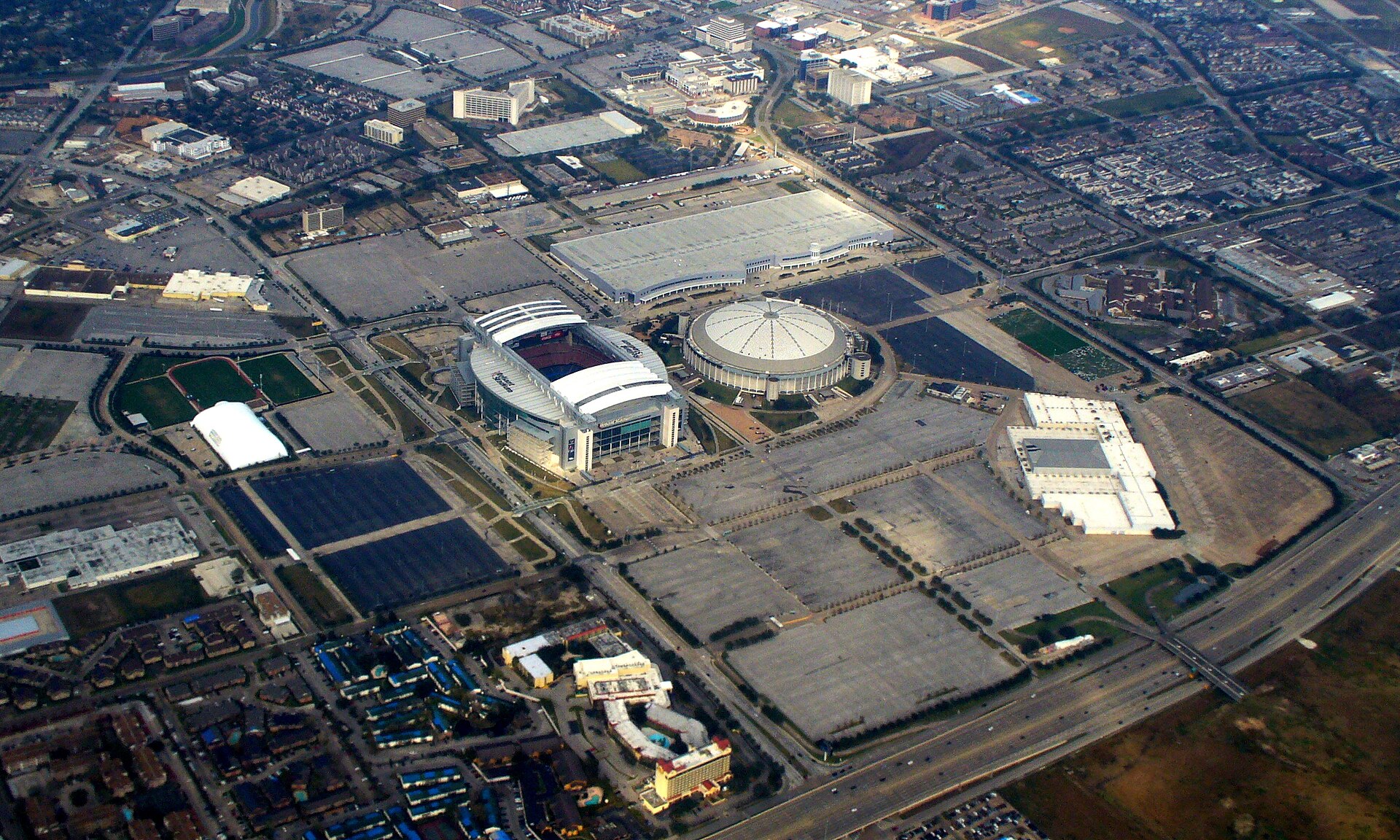
The stadium stands in southwest Houston, inside NRG Park. The site sits between Kirby and Fannin, close to South Loop 610. It is not an isolated stadium. It is part of a large event complex with NRG Arena, NRG Center, the Astrodome and wide outdoor spaces around them. On busy days, this part of Houston is built to move people in large numbers. Cars arrive from the loop. The METRORail connects the site with the Texas Medical Center and downtown.
NRG Stadium was built for two very different worlds. It became the home of the Houston Texans, the NFL team that brought professional football back to the city. It also became a home for the Houston Livestock Show and Rodeo. That second use matters. The stadium had to work for football fields, rodeo dirt, livestock, concerts, vendors and crowds that came for more than a match. Its retractable roof helped solve that problem. The NFL wanted the feeling of open air football. The rodeo needed a controlled indoor space.

That flexibility made the stadium useful from the start. It could hold around 72,000 people for major events, while FIFA lists Houston Stadium at 68,311 for the World Cup. In 2026, the roof, the field and the branding will all be adjusted for global football. Yet the deeper story of this place does not begin with FIFA. It begins with the ground around the stadium. Before Houston Stadium became a World Cup venue, this same event complex had already shown how a stadium site can serve a city in ways no fixture list can predict.
The Dome Next Door
Before Houston Stadium stood here, another building made this ground famous. The Astrodome opened in April 1965, when Houston was still trying to prove itself as a major league city. Baseball in the open air had been hard work. The heat was heavy. The humidity stayed in the stands. Mosquitoes were part of the matchday experience. The answer was not a better open stadium. Houston built a roof over the whole idea.
The Astrodome was a bold building for its time. It was enclosed, air conditioned and built for many uses. Baseball, American football, rodeo, concerts, conventions and public events all passed through its doors. Inside, the temperature could be controlled. Outside, Houston could present itself as a city of engineering and ambition. The Dome was not only a place to watch sport. It was a way for Houston to show what kind of city it wanted to become.

That future did not last in the same form. The Houston Oilers left the city after the 1996 season. The Astros moved out after 1999. RodeoHouston followed after 2002. By then, Reliant Stadium had opened next door. It gave the Texans a new home and gave the rodeo a larger modern stage. The old Dome was still standing, but its role had changed. It was no longer the main engine of the site.
By 2005, two different versions of Houston stood on the same ground. One was the Astrodome, the older indoor landmark that had once promised a new future. The other was Reliant Stadium, the newer football and event venue that would later become NRG Stadium and Houston Stadium. Around them were Reliant Center, Reliant Arena, parking lots, access roads and spaces built for crowds. When Hurricane Katrina forced thousands of people out of New Orleans, that wider complex became important. Houston did not only have an old stadium available. It had a whole stadium complex that could be turned toward emergency use.
Buses From New Orleans
Hurricane Katrina reached the Gulf Coast at the end of August 2005. The storm had formed over the Bahamas, crossed Florida and became stronger above the Gulf of Mexico. On 29 August, it made landfall near Buras, Louisiana, before moving again near the Louisiana and Mississippi border. In New Orleans, the damage did not stop with the wind. Water entered large parts of the city after levees and floodwalls failed or were overtopped. Roads were blocked. Homes and businesses stood in flooded neighbourhoods.
Many residents had already moved to large shelters inside New Orleans. The Superdome and the Convention Center became crowded places for people who could not leave earlier or had nowhere else to go. But those buildings could not support people for long. Power, food, water, medical care and transport were all under pressure. Federal reports later described how buses were requested from the Superdome. The Department of Transportation then began assembling more than 1,100 vehicles to move people away from the city.
Houston became one of the main places where evacuees were taken. It had roads, public agencies, medical capacity and a large event complex that could be changed quickly. On the morning of 1 September, buses began arriving at Reliant Park from Louisiana. The Astrodome became the first receiving point. People could enter there and be checked for urgent medical needs. But the number of arrivals kept growing, so Reliant Center and Reliant Arena were also brought into use.

By then, the old sports site had become part of a wider emergency operation. The shelter work centred on the Astrodome, Reliant Center and Reliant Arena, not on the NFL stadium itself. At the peak, about 27,000 people were housed across the Astrodome and Reliant Park complex. Many more passed through Houston and Harris County. What had been built for games, rodeos and large events was now being used for something more basic. People needed a place to arrive, rest, register and begin looking for what came next.
View the Houston Chronicle’s powerful and unsettling photo series from inside the Astrodome.
Life Inside Reliant Park
Inside the Astrodome, arrival slowly became routine. Thousands of people slept on cots spread across the stadium floor. Bags stood beside families. Children played with puzzles, bubbles and Red Cross packages. Some people prayed before meals. Others walked through the Dome with names written on paper, looking for relatives they had lost somewhere between New Orleans and Houston.
The wider complex had to support needs that changed by the hour. People needed food, showers, medicine, clean clothes and a place to ask questions. Doctors and nurses worked in medical spaces at the Astrodome and Reliant Center. A pharmacy, paediatric care and mental health support became part of the operation. Reliant Stadium was not the main shelter, but its kitchens helped prepare meals. The site worked because it had been built for crowds, movement and large events.
There was safety here, but little privacy. Public announcements echoed through the Dome during the day and night. Notes appeared on walls and boards as evacuees searched for missing family members. More organised systems came later, but waiting remained part of daily life. Children were taken by bus to school. Adults waited for news about housing, work, money and relatives. The shelter gave people structure, but many answers still lay outside its walls.
As the days passed, Reliant Park became more organised. Services were added. Volunteers guided people through lines. Medical teams treated urgent cases and long untreated conditions. Families packed belongings when they moved to other spaces or prepared to leave. The Astrodome could offer a cot, a meal and a roof. Reliant Center and Reliant Arena could add clinics, support desks and more space. But no stadium complex could solve what came after the flood. It could hold people for a while. It could not give them back the homes they had left behind.
What Houston Carried Forward
After the first emergency days, Reliant Park slowly emptied. Not all at once. Some people moved from the Astrodome and Reliant Center into Reliant Arena. Others were placed in apartments, hotels, other shelters or temporary housing. For many, leaving the Dome did not mean returning home. It meant entering another stage of uncertainty. Houston had offered safety, but now people needed schools, jobs, health care, documents, transport and a place where daily life could begin again.
That aftermath changed Houston. More than 200,000 evacuees came to the area after Katrina, and later estimates suggest that roughly 50,000 to 60,000 stayed for the long term. Schools absorbed thousands of new students. Clinics treated people whose needs did not end when the shelter closed. Churches, charities, apartment owners and public agencies helped people move from cots to rooms, from emergency meals to regular routines. The response was praised because Houston acted quickly and opened its doors at scale. It was also imperfect. Registration was difficult. Information was uneven. Families were hard to find. Housing took time. A stadium complex could receive people. It could not rebuild a city for them.
The lessons were practical. Large shelters need more than space. They need medical care, mental health support, security, food systems, clear information, registration, transport and a plan for what happens after people leave. Reliant Park showed the value of buildings made for crowds, but also their limits. The Astrodome could hold thousands, yet it could not give privacy or certainty. It became useful again in a crisis, after losing its old place in Houston sport. After 2005, the Dome never returned to public life in the same way. It was later closed to the public and remains beside NRG Stadium as a building caught between memory, cost, preservation and debate.
Next to it, the newer stadium stayed active. The Texans played on. The rodeo returned each year. Concerts and major events continued to fill the calendar. In 2026, NRG Stadium becomes Houston Stadium for the World Cup. Crowds will again arrive at the same ground from far beyond the city. The circumstances could not be more different. Still, the memory of 2005 remains beside the route into the stadium. Reliant Park showed that stadiums are not only places for events. In rare moments, they become part of how a city cares for people.