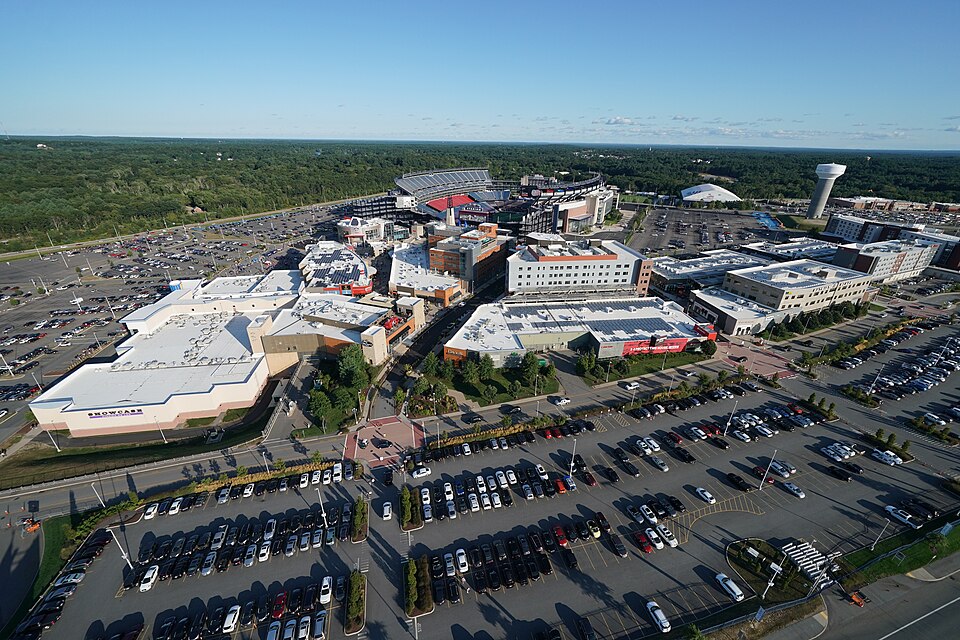
Gillette Stadium car culture begins before the stadium comes into view. It starts on the roads south of Boston, where cars move towards Foxborough from different parts of New England. This is not a stadium hidden inside a city grid. It is a regional destination shaped by highways, parking lots and the long hours before kickoff. Around Gillette Stadium, the journey is part of the event. Fans arrive early and turn the parking lot into a place eating and drinking together. To understand matchday in Foxborough, you first have to understand the road that brings people there.
Tailgating in the US
In the United States, a sports day often starts on the road. The car is not a small detail in that journey. It is part of the way many people move through daily life. American football stadiums often reflect this. They need roads and space for crowds that travel from wide areas. One analysis of the RFK site in Washington noted that the average NFL stadium includes around 20,000 to 25,000 parking spaces. That averages one available parking spot for every three seats. These spots are not only used for functional parking, the crowd gathers here long before they reach the stands.
Here tailgating begins. Fans arrive early and use the parking lot as a meeting place. They open trunks and coolers. They set out folding chairs and tables. Food is prepared beside cars. They socialise before they move towards the stadium. Other countries have pre match rituals too. Fans gather in pubs, streets, cafés and squares before a game. Tailgating is different because the car sits at the centre of it. A YouGov survey from April 2026 found that 37 percent of American adults had attended a tailgate for a sporting event. Another 46 percent said tailgating was very or somewhat important to the overall experience.

Those numbers show why tailgating is not only a local habit. It is recognised as part of North American sports culture. In the same YouGov survey, adults were asked about some 2026 World Cup venues in the United States not allowing tailgating before or after matches. 30 percent disapproved, while 26 percent approved. It shows how a parking lot ritual from American football can meet a global tournament. For this tournament organisers clearly want more people to reach stadiums without a car. However, the adjustments are temporary and tailgating culture will return after the World Cup.
A Stadium Outside Boston
Foxborough became home because Boston could not give the Patriots a permanent stadium. The club had moved between Fenway Park, Boston College and Harvard Stadium. A proposed 16 million dollar stadium in Boston was voted down, so the Patriots looked to the suburbs. On 4 April 1970, Foxborough was selected as the new playing site. The argument was built around access. Owner Billy Sullivan pointed to the highways around the town and to its wider regional reach. From Foxborough, the team could draw from a larger population than from Boston itself. Two weeks later the town approved the move. By September, work had started on a 62,000 seat stadium.
The first night tested that promise. On 15 August 1971, the Patriots opened Schaefer Stadium with a preseason game against the New York Giants. It was meant to be a celebration. The team finally had a fixed home after years of moving around Boston. The crowd was announced at 60,423, then the largest in Patriots history. But by midafternoon, the roads that had helped bring the stadium to Foxborough were already overwhelmed. Route 1 was full. Cars stretched for miles. Thousands of fans were still outside when the game began at 8.30 p.m. Some never reached their seats at all.
That opening night became part of the stadium’s local memory. Fans sat for hours in overheated cars. Some left their vehicles and walked the final miles to the stadium. Plumbing problems added to the chaos and the town later pushed back against night games. Even after the final whistle, cars were still trying to leave the parking lots at 2.30 a.m. Some fans did not get home until dawn. Foxborough had been chosen because the highways could bring a region to football. Opening night showed that the road to Foxborough came with obstacles of its own.
How Gillette Stadium Manages the Road
More than 50 years later, that road still shapes the stadium day. Gillette Stadium is newer, larger and more organised than Schaefer Stadium ever was. But the basic challenge has not disappeared. Thousands of cars still have to reach Foxborough and leave again through the same road system. In 2019, the Patriots continued a parking plan built around that pressure. Fans could park for free in Lot 55, but only if they waited 75 minutes after the game before leaving. The idea was simple. Every car that stayed behind was one less car fighting to get onto Route 1 after the final whistle. The stadium now even offers incentives for fans who choose delayed exit parking.

For the 2026 World Cup this stadium will be called Boston Stadium. But it is not in Boston. The stadium stands in Foxborough, a town about 34 kilometres (21 miles) southwest of downtown Boston and about 40 kilometres (25 miles) northeast of Providence. That location matters. It places the Patriots between two larger cities rather than inside either one. Fans can come from Boston, Rhode Island and smaller towns across the region. The name New England fits that geography. This is not a club tied only to one city street or one urban neighbourhood. It is a regional team, and its stadium is reached like a regional destination.

That regional crowd has to be divided before the game can begin. Gillette stadium offers several parking options for visitors. Some fans pay to park on the stadium side of Route 1. Others use free general parking across the road. Others choose delayed exit parking, where leaving later is part of the agreement. These choices look like service options, but they also manage movement. They spread cars across different lots and reduce the rush after the final whistle. At Gillette Stadium the road is not just the way in. It is part of the stadium’s rhythm, from the first arrival to the final exit.
When the Parking Lot Becomes the Matchday
On a Patriots matchday not even everyone comes to Gillette Stadium with a ticket. Some come for the hours around the game. In a Boston Globe photo column, Stan Grossfeld described fans gathering in the snow before a Patriots game against Buffalo. There were grills, sausages, peppers, onions, homemade soup, coolers, tables, televisions and old friends. Al Wilhe came from South Kingstown in Rhode Island and watched from the lot with people he knew. Katherine Jacobsky took a bus from Portland in Maine. Her package included transport and a tailgate, but no ticket. She still treated the trip as worth it.
That is what makes the Gillette parking lots different from ordinary car parks. Some fans watch from chairs beside their cars. Others stay under canopies or move to bars at Patriot Place, where the stadium is close enough to hear and partly see. Joe Douglass came from Maine without tickets and cooked several dishes beside his setup. For him the tailgate was the reason to make the trip. Around Gillette Stadium the stands are not always the first destination. Sometimes the parking lot is.
There are other ways to reach Gillette Stadium, but they usually sit around the car based rhythm rather than replacing it. For Patriots games, special event trains run to Foxboro from Boston and Providence. There are also rideshare and taxi zones near the stadium. Still, the normal matchday is built around early arrival and time beside the car. That balance will be tested during the 2026 World Cup. Parking will be cut to around 5,000 spaces, far below the usual 20,000. Public transport is being pushed to the front. Far fewer parking spaces will be available at most World Cup venues. Extra security perimeters, hospitality buildings and media spots cover big parts of what are normally parking spots. The MBTA plans up to 14 trains on matchdays and wants to move as many as 20,000 people by rail. For a few weeks, Boston Stadium will have to work less like a Patriots home and more like a global football venue.
The 2026 World Cup will briefly change the rhythm. Parking options shrink and trains will matter more. Gillette Stadium will have to work in a way that feels different from a normal Patriots day. But the deeper pattern will not disappear. Gillette Stadium was built around arrival by road, and its matchday culture still grows from that fact. The cars come first. The lots fill before the stands. People gather, wait and move together towards the game. When the tournament leaves, the Gillette Stadium car culture will return. The parking lots and a stadium day that begins long before anyone takes a seat.