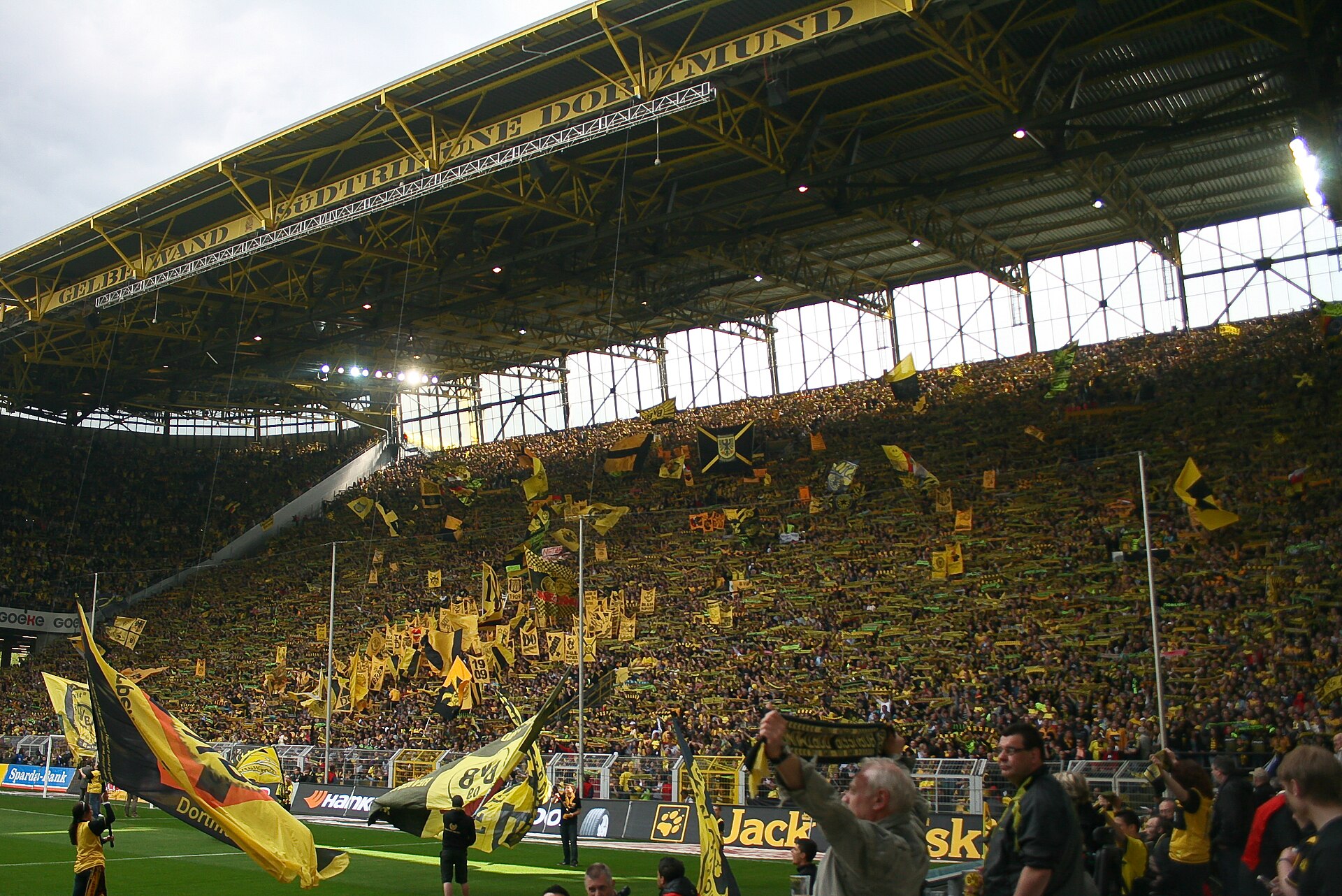
Long before they arrive in Dortmund, most visitors already know what the Yellow Wall is supposed to look and sound like. Yellow shirts rising almost from pitch to roof. Flags disappearing into smoke. Thousands of voices folding into one. The image has travelled so far that the Südtribüne can feel familiar before you have ever climbed its concrete steps.
Sometimes the real thing delivers exactly what the imagination promised. Sometimes an ordinary Saturday feels more ordinary than the legend allows. And in the space between those two experiences, the rumours begin.
In recent months, visitors have again asked whether Dortmund’s famous atmosphere is overrated. One British supporter compared a trip to Düsseldorf, Dortmund and Cologne and left the Westfalenstadion wondering why the Yellow Wall had felt the quietest of the three. German supporters joined the discussion with familiar explanations about ageing season-ticket holders and a terrace whose fame attracts people who want to witness the atmosphere as much as create it. Other visitors approached Dortmund from the opposite direction: supporters from Australia, Denmark and the United States asking how to get onto the Süd, which songs to learn and what is expected of them once they are there.
It sounds like a very modern problem: a football culture becoming so famous that people travel across continents to test it against its reputation. Except Dortmund supporters were worrying about almost the same thing more than a decade ago.
In February 2013, The Unity, one of Dortmund’s established ultra groups, published an unusually severe reflection on the Südtribüne. Borussia were reigning German champions. Jürgen Klopp’s team had become one of Europe’s most exciting sides. Admiration for Dortmund’s stadium culture was spreading far beyond Germany. Yet inside the stand, there was unease. The writers wondered whether all the praise surrounding the Südtribüne, the Westfalenstadion and Dortmund’s atmosphere was becoming little more than folklore. They even turned the accusation inward, had supporters themselves become tourists inside their own success?
Perhaps the more interesting question is what happens when a football terrace becomes famous enough that reality has to compete with its own mythology.
Why the Dortmund Yellow Wall feels bigger than just a stand
When the Westfalenstadion opened for the 1974 World Cup, the ground held around 53,000 people, most of them standing. The Südtribüne that now dominates photographs of Dortmund came later, growing in stages as the stadium expanded around it. By the end of the 1990s the south stand had reached its current scale. A single terrace with room for 24,454 standing supporters. The largest standing terrace in Europe.

That number matters less when you read it than when you imagine it. 24,454 people behind one goal is not really a crowd anymore. It is closer to a small town tipped on its side. From the opposite end of the pitch, individual supporters disappear. Faces become colour. Flags merge into the stand behind them.
This is part of the secret of Dortmund. The architecture does not create the atmosphere, but it gives collective behaviour a scale large enough to become visible. A few supporters jumping is movement. Twenty thousand doing it together can make concrete appear to breathe.
While this is currently the most recognisable version of the Südtribune, its history speaks for itself. It was enlarged, reorganised and filled by different generations. Supporter groups formed around it. Songs changed. Habits changed. The image the world now treats as one of football’s great traditions was itself the result of decades of adaptation.
How Dortmund’s Yellow Wall became a global image
Today there are effectively two Yellow Walls. One exists in Dortmund, where 24,454 people can stand behind the goal. The other lives on television, phones and laptops around the world.
Borussia Dortmund’s numbers show how enormous that second audience has become. By 30 June 2025, the club reported 80.7 million follows across its social-media platforms, up from 74.5 million a year earlier. Membership had climbed from 204,483 to 229,839, while the number of official BVB fan clubs increased from 1082 to 1152.
The numbers tell their own story. The Südtribüne can hold 24,454 people, but the image created there now travels to millions around the world. What happens behind one goal in Dortmund is seen far beyond the city. The Yellow Wall has become a global football image, built by the people on the Süd and recognised everywhere football is watched.
That global image also shapes expectation. Many visitors first know Dortmund through choreographies, European nights and the loudest moments the Südtribüne has produced. When they arrive at the Westfalenstadion, they are often comparing an ordinary match with years of highlights.
Have tourists changed the Dortmund Yellow Wall?
One explanation returns whenever the Yellow Wall feels quieter than expected. Dortmund became famous, tourists arrived and the people who once made the atmosphere slowly gave way to people who came to watch it.
However, the numbers suggest something else. Borussia Dortmund has around 55,000 season-ticket holders in a stadium of 81,365, and in recent years only about 100 season tickets a year became available while more than 50,000 people were waiting for one.
This summer, around 600 season tickets were reassigned for 2026/27. Even that is a small shift inside a stadium dominated by long-term holders.
Visitors do get onto the Südtribüne, but the idea that tourists have simply pushed out Dortmund’s traditional support is hard to match with how little access changes from year to year. The bigger question may be how a new generation gets in at all.
The Südtribüne has a challenge: generations
Football culture romanticises the supporter who never leaves. Someone who has stood in the same part of the stadium for thirty years carries memory with them. They remember different managers, different players, terrible seasons and extraordinary ones. Songs do not need explaining. Rituals become instinct.
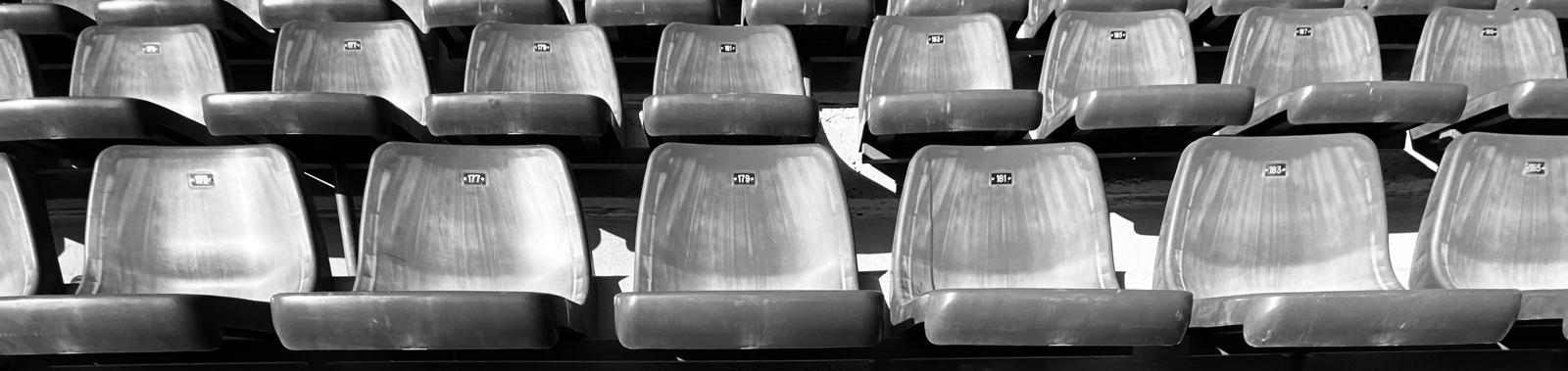
But thirty years of loyalty also means becoming thirty years older. BVB’s own Fanrat has discussed the high average age of season-ticket holders. And in May 2026 the club introduced a revealing new option, for the first time Südtribüne standing season ticket holders could apply for a permanent move to a seated spot. Giving older supporters and people with disabilities priority.
There is nothing tragic about that. It is simply what continuity looks like. The same loyalty that makes a football terrace culturally powerful can make renewal difficult. Places are scarce precisely because people value them enough not to give them up.
Dortmund is not alone in facing an older football audience. A large 2025 survey of German football fans found that people aged 50 to 59 formed the biggest age group, with supporters over 70 the next largest. The Südtribüne has its own history and ticket structure, but the question of how one generation makes room for another reaches far beyond Dortmund.
The challenge for Dortmund is therefore not choosing between old supporters and young ones. That would reduce supporter culture to demographics. It is allowing generations to overlap. Preserving the memory of people who built the culture while creating enough openings for others to learn how to carry it forward.
And inside Dortmund, that work is already happening in another way.
Dortmund’s Yellow Wall does not sing by itself
The Yellow Wall is often spoken about as if the noise belongs to the stadium itself. Dortmund’s active supporters know better. At the start of the 2024/25 season, The Unity looked back on a difficult year and admitted that the Süd had fallen below its own standards for long stretches. The atmosphere improved again as Dortmund’s Champions League run gathered momentum, but the message was clear. Even here, noise comes and goes.
Rather than retreat into nostalgia, supporters started working on it. The active Stimmungskern was expanded, with more attention given to where singers stood, where drums were placed and how neighbouring sections could be pulled into the songs. The famous image from outside is built from details like these.
That is what makes Dortmund interesting. The Yellow Wall is not a machine that switches on when the teams walk out. Someone has to start the song, someone has to keep it alive when the match turns flat, and thousands of others have to decide to join in. The Südtribüne can hold 24,454 people, but the atmosphere only appears when enough of them choose to make it together.
Why Dortmund still lives up to the legend
The Yellow Wall is judged against an image that has travelled much further than Dortmund itself. Social media rarely shows the ordinary afternoons. It shows the choreographies, the European nights and the moments when the Südtribüne seems to move as one. Arrive with only those images in mind and almost any normal league match risks feeling smaller than expected.
That does not mean every criticism should be dismissed. Dortmund’s own supporters have been questioning the atmosphere for years, and the work around the Stimmungskern shows that concerns about participation and renewal are real. The Süd has never survived by pretending everything is perfect. It survives because people inside it care enough to argue about what it should be and then try to make it better.
Perhaps that is what the outside world misses. The Yellow Wall is not impressive because it produces ninety minutes of noise on command. It is impressive because thousands of people keep returning to the same terrace and trying to create something together. Some afternoons are louder than others. Some generations make room for the next. The famous image is only the brightest version of a culture that exists every week.
And that is why Dortmund is still worth the journey. Walk towards the Westfalenstadion, watch the yellow gather around the city, climb into a stand large enough to hold almost twenty-five thousand people and you begin to understand what the videos leave out. The Yellow Wall is not a performance waiting for an audience. It is a living part of Dortmund.
When the crowd, the match and the moment come together, the legend suddenly makes perfect sense. Dortmund does not stage the Yellow Wall for the world. The world is simply invited to witness what happens when a city stands behind its team.