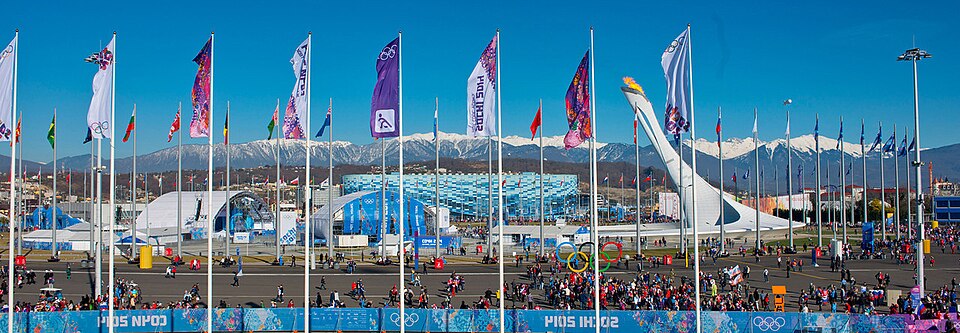
The Fisht Olympic Stadium in Sochi was built for the 2014 Winter Olympics, which cost an estimated €47 billion and became the most expensive Olympic Games in history.
The Fisht Olympic Stadium Sochi sits on the edge of the Black Sea. In the flat expanse of the Imeretinskaya Lowland. To the south lies open water. To the north rise the foothills of the Caucasus. The stadium’s white roof curves like a snow covered mountain peak. A deliberate echo of the Winter Games it was built to host. In 2014 it stood at the heart of the Olympic Park, surrounded by newly built arenas and plazas. To present a modern Russia to a global audience.
Before the Olympics, this landscape looked very different. Sochi was known as a summer resort rather than a winter destination. Russians came for beaches and a mild subtropical climate. Snow sports belonged to the mountains far inland. The lowland near the coast was quiet and sparsely populated. Wetlands stretched across the plain. Small houses stood among farms and orchards. Migratory birds used the marshes as a resting point. It was not a place shaped for spectacle.
A Bold Bid
In 2007 the International Olympic Committee awarded the Winter Games to Sochi. The IOC awarded the Games to Sochi as Russia’s first Olympics since the fall of the Soviet Union. Vladimir Putin personally led the bid, presenting the project as proof of a stable country returning to the world stage. The bid aimed to show that Russia had moved beyond the political chaos of the 1990s.
Choosing a place that until then had been defined by emptiness rather than infrastructure. The planners redesigned marshland and scattered farms as an Olympic stage. The bid assumed a near total reinvention. Almost everything had to be built from scratch, including the Fisht Olympic Stadium Sochi. Roads cut through former wetlands. Railways and tunnels followed. Power stations and sewage systems replaced orchards and reed beds. The Russian government created Olympstroy was to manage the project. Tens of thousands of workers arrived. From reclaimed coastal land, the stadium rose quickly. Becoming the most visible marker of how completely the landscape was being rewritten.

The design came from an international architectural team. The roof was allowed daylight to filter in while keeping the structure visually light. From the stands, spectators could see both the sea and the mountains. Building on soft ground brought engineering challenges. Engineers stabilized the soil before laying the foundations. The stadium was never intended to host sporting competition during the Games. It was planned as a ceremonial space, a stage rather than an arena.
Global Platform
In February 2014 the opening ceremony unfolded inside the stadium. It was a carefully choreographed production that moved through centuries of Russian history. Millions watched around the world. The organisation impressed many observers. Transport worked. Volunteers guided visitors. The show ran on time. For a brief moment, the Games appeared to deliver exactly what they promised. The stadium functioned as a platform for international prestige.
Not everything went smoothly. During the opening scene, one of the five snowflakes failed to unfold into an Olympic ring. Leaving the symbol incomplete inside the stadium. Russian state television cut to rehearsal footage in which all five rings appeared as planned. A decision later confirmed by the producers. The creative team acknowledged the malfunction and its cause. Turning a brief technical failure into a quiet footnote beneath an otherwise polished spectacle.

Behind the scenes, the scale of the project raised questions. Analysts estimated the total costs at around €47 billion. About 85% of those costs were spent on non-sports infrastructure. That figure made it the most expensive Olympic Games ever staged at the time. For comparison, the Winter Games in Vancouver in 2010 cost roughly €6.5 billion. The difference was largely explained by the lack of existing infrastructure in Sochi. Every major connection had to be created.
The Costs of Speed
Attention increasingly focused on individual projects. One of the most discussed was the combined road and rail link connecting the coast to the mountain cluster. The 48 kilometre route reportedly cost around €8 billion. Officials cited difficult terrain and compressed timelines. Critics questioned procurement processes and transparency. These debates became inseparable from the stadium itself. The arena stands in a park that embodied both ambition and excess.
Labour conditions added another layer. Between 70,000 and 100,000 workers were involved in Olympic construction. Many were migrants from Central Asia. Reports by Human Rights Watch documented cases of unpaid wages and overcrowded accommodation. Some workers reported that passports were withheld by employers. The pace of construction left little margin for oversight. These realities formed part of the story behind the stadium’s smooth white exterior.
Nature and Environment
The natural environment of the lowland changed permanently during the Olympic build-up. What had been a protected and ecologically sensitive area became a vast construction zone. Prompting repeated warnings from environmental groups and international experts. Built over wetlands in the Imereti lowlands as Olympic facilities and infrastructure advanced. Reports by UN Environment Programme experts concluded that the construction caused irreversible damage to animal habitats and river ecosystems. Authorities pointed to compensating steps, including the creation of a protected bird area. However, environmental groups argued that these efforts could not replace what had been lost.
Local communities were affected alongside the landscape. Construction spread into areas where houses, farms and protected land stood. Including parts of Sochi National Park and the Imereti Lowland. Environmental activists and residents protested land allocation decisions and the removal of protected status from natural sites. They warned that development was proceeding without proper oversight. Some residents accepted relocation and compensation. Others argued that land was reassigned without enough regard for environmental law or local interests. Over time, a lived landscape was replaced by Olympic venues, roads and power infrastructure. Turning everyday space into a concrete plaza.
After the Olympics
The closing ceremony took place on 23 February 2014. Within days, geopolitical events in Ukraine reshaped international perceptions. The annexation of Crimea and the Donbass altered the narrative around the Games. What had been framed as a celebration of cooperation began to look like the end of a diplomatic chapter. The stadium itself did not change, but its context did. The Olympic moment closed almost as quickly as it had opened.
After the Games, the stadium entered a period of uncertainty. It remained closed for several years while plans were revised. Fisht Olympic Stadium Sochi was selected as a venue for the 2018 football World Cup. That decision required significant alterations. The original roof had to be partially removed to allow natural grass and open air conditions. The conversion cost roughly €55 million. Capacity was increased to over 40,000 seats.
During the World Cup, the stadium hosted several matches, including a quarter final. The atmosphere was different from 2014. Supporters arrived from across the world. The focus shifted from ceremony to competition. For the first time, the stadium proved it could function beyond symbolism. The Olympic Park adapted to a new rhythm. For one summer, Sochi became a football city.
Today the stadium is home to FC Sochi. League matches fill the stands on weekends. The surrounding park is used by residents for walking and cycling. A Formula 1 circuit weaves through the former Olympic site. Tourists visit the coast and pass through the plazas that once hosted medal ceremonies. The stadium is no longer a temporary showcase. It has become part of the city’s everyday infrastructure.
What remains
The meaning of the Fisht Olympic Stadium Sochi remains contested. For some it stands for national ambition and technical achievement. For others it represents environmental loss, labour pressure and extraordinary cost. Those interpretations sit side by side in the concrete, without resolution.
What endures most clearly is the lesson that followed. The scale and expense of Sochi is one of the examples forcing the Olympic movement to rethink how the Games should be staged. Sustainability and reuse moved to the centre of planning through Olympic Agenda 2020. The era of building entire Olympic cities from scratch began to close.
That shift is visible in the upcoming Winter Olympics, Milano Cortina 2026. Instead of creating new landscapes, the Games will rely largely on existing arenas and long used winter venues spread across northern Italy. The Olympics will adapt to their surroundings rather than reshape them.