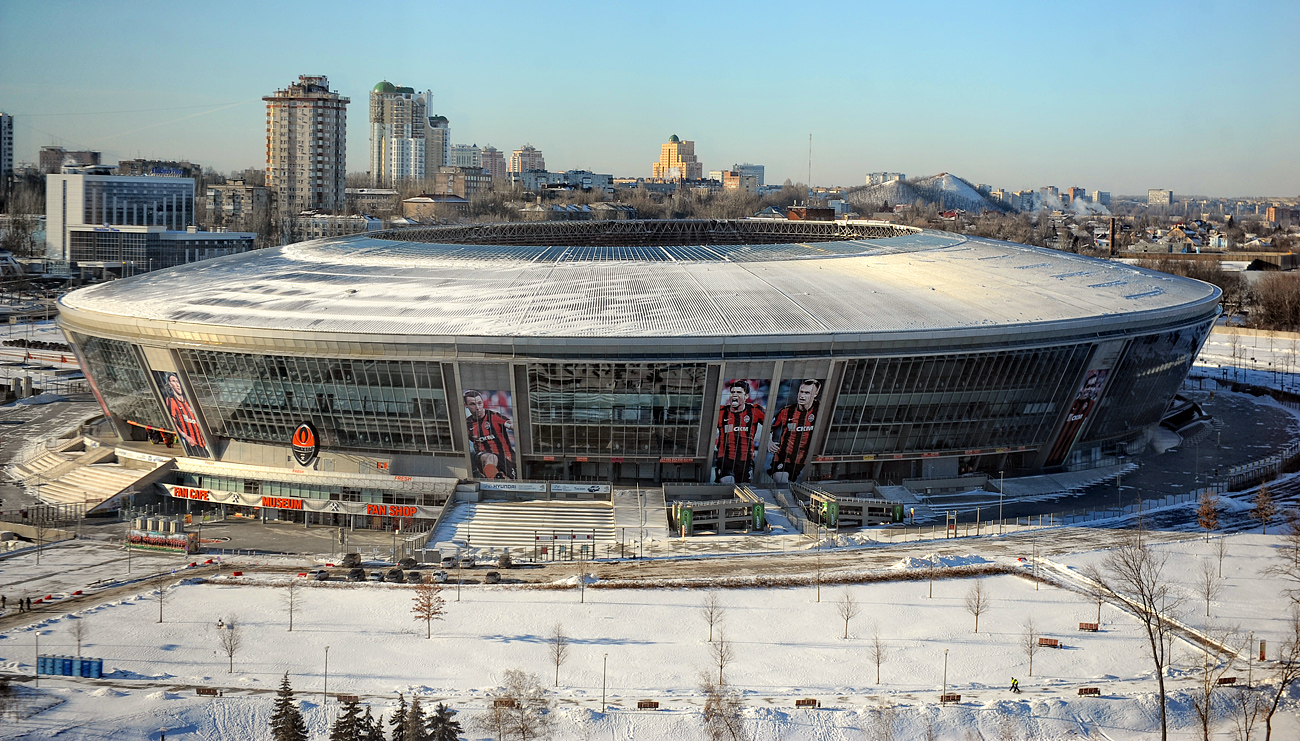
The Donbass Arena in Donetsk opened in 2009 and was damaged during shelling in 2014. As of 2025 it remains closed and inactive due to the ongoing conflict in eastern Ukraine.
29 August 2009, streets filled with people walking towards the new Donbass Arena, many carrying small flags or selfmade signs. Families stood together in the park around the stadium, while sellers handed out snacks and beers. The talk was not about tactics or line-ups but about the new Donbass Arena. Locals had bought tickets for the opening show convinced this would be a once-in-a-lifetime moment for their city.
That night Donbass Arena opened. It stood as proof that Donetsk could build something world class with its own hands. The ceremony mixed glamour with local spirit and left the crowd believing that the city had stepped into a new chapter. Pride filled the night air but beneath the celebration a larger story was already taking shape. One that would reveal what the arena truly meant for the region.
built to impress
When the fireworks faded after opening night one question echoed through Donetsk. For decades the Donbas had been Ukraine’s industrial heart known for its mines, furnaces and heavy labour. Wealth ran through steel and energy, yet the region’s image never matched its worth. In the mid-2000s global prices for coal and metal were shooting up. Donetsk’s elite suddenly had both the money and the confidence to dream bigger. Out of that came Rinat Akhmetov’s vision. The billionaire owner of Shakhtar Donetsk poured around four hundred million euro into an arena that would showcase Donetsk’s new confidence and ambition. Often described as the crown jewel of his empire, the Donbass Arena was built to reshape the city’s image and present the Donbas as a region of progress.
The design carried that same ambition. British engineers from Arup Sport who had helped shape stadiums such as the Etihad in Manchester and the Allianz in Munich crafted an oval of steel and glass that sat within the park. Around 50,000 seats held court inside, lit by a roof inclined north to south so daylight could reach the pitch. At night the glazed façade and glowing outline stood out above a city once defined by its steelworks.
Beyond its design the stadium helped accelerate development around Donetsk. A cluster of hotels and restaurants grew near the arena and the wider city showed signs of modernisation in the years before the war. Shakhtar’s strong runs in Europe added to the sense of pride, each match strengthening the idea that Donetsk had entered a new chapter.
Shakhtar were champions every season and had become the pride of Ukraine. In May 2009 they won the UEFA Cup against Werder Bremen in Istanbul, the country’s first major European trophy. Crowds filled the streets of Donetsk with horns, fireworks and flags. The new stadium, still shining and modern, became part of that celebration. Three years later it hosted Euro 2012. Donetsk was on television across the continent, and locals believed the city had finally claimed its place in Europe.But beneath that confidence the ground was already shifting. The arena would soon sit in the middle of uncertainty, its lights reflecting a region on the brink of change
How things changed
The change began with the arrival of the little green men. That is the name locals gave to the soldiers in unmarked green uniforms who appeared across eastern Ukraine in early 2014. They carried Russian weapons but no flags, and no one admitted who they were. When they reached Donetsk the mood shifted completely. Fear replaced pride. The same streets that once carried orange banners were now filled with checkpoints and barricades. The stadium stood silent in the middle of it all, its glass reflecting a city that no longer trusted what tomorrow might bring.
By autumn that turned into visible damage. Shells struck near the Donbass Arena and part of the roof was torn apart. The blast shattered panels on the outer ring and left chunks of concrete scattered across the park. Windows in nearby buildings broke from the shockwave. No one was killed inside, but the ground was no longer safe. Staff sealed off entrances and the club removed what equipment they could. Reuters reported that two explosions had hit the site in October 2014, forcing all activity to stop. The lights that once shone across the city stayed off, and the stands filled with dust instead of people.
leaving donetsk
The team moved first to Lviv on the western side of Ukraine, nearly a thousand kilometres from home. Matches were played at the Arena Lviv, far from the club’s roots and supporters. Later they settled in Kharkiv, a city that shared their eastern identity but remained outside the conflict zone.
For the people of Donetsk the departure of their club could be defined as insignificant compared to what else they experienced. Families fled to other regions as fighting increased, leaving homes and jobs behind. Many supporters tried to follow Shakhtar’s games from temporary shelters or new apartments in Kyiv and Dnipro. Jam News wrote that fans scattered across the country kept wearing their orange and black scarves in public as a quiet reminder of where they came from. Others could only watch highlights online when electricity allowed. Watching Shakhtar play every other week was replaced by a different kind of routine built around survival.
Some supporters never left. They stayed in Donetsk, saying the city was still theirs even as the war changed everything around them. In interviews with Radio Svoboda local ultras described how following Shakhtar had become almost impossible. Internet connections failed often, official fan gear no longer arrived, and the usual chants were replaced by sirens and long moments of silence.
For more than ten years Shakhtar Donetsk have played without a home. The team travels from one stadium to another. Since leaving Donetsk they have played in Lviv, Kharkiv, Kyiv and most recently in Warsaw. Each ground welcomes them for a while, but none of them truly belong to the club. The players have spent years moving between hotels and training grounds far from their families. They admit that the memory of Donetsk and the old arena never really leaves them, but the matches remind them it’s about pride and survival.
The club has learned to live with distance. In 2024 they trained and played while the war continued, moving between Kyiv and European cities for safety. Some players lost relatives back east, others sent money home. CBS Sports wrote that Shakhtar have become a symbol of Ukrainian endurance, a team that keeps playing despite the constantly changing circumstances.
Fans continue to adapt. Supporter groups now meet in cafés in Kyiv, or gather in Poland and Germany when the club plays abroad. They bring drums, banners and old scarves from Donetsk. On social media they post videos of matches streamed from small flats and refugee centres, sharing the same chant that once echoed through the Donbass Arena. The stadium itself remains closed and guarded, a silent witness to how much the club and its people have changed.
The Donbass Arena was built to last for generations. Yet it took only five years from the first fireworks in 2009 to the first shells in 2014, the distance between triumph and tragedy was painfully short. Winning a UEFA Cup and playing in this new arena Donetsk could stand alongside the great football cities of Europe. Its rise and fall mirrors the story of the Donbas itself, a place of hard work, pride and resilience that was never given the peace to enjoy what it built.
Today the arena stands empty and damaged. Every chant, every shared memory, is a quiet promise that they will return. The people of Donetsk deserve that chance. A chance to walk through their gates again, to fill the stands with colour instead of dust, and to see their city shine as it once did. Until that day comes, all that remains is hope. And unlike Shakhtar, hope has never left this place.