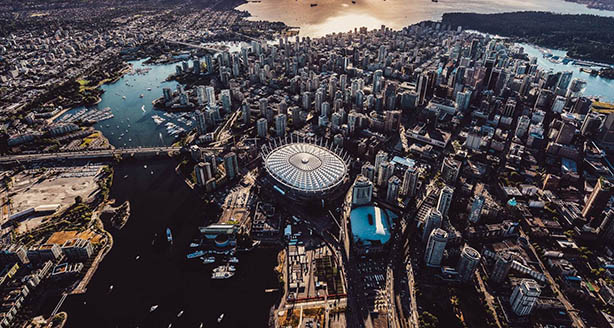
BC Place Vancouver sits at the heart of a city that learned how to receive the world. Built in the early 1980s the stadium stands beside the waters of False Creek. Vancouver first stepped onto a global stage during Expo 86. From that moment on, the same ground has continued to host events that reach far beyond the city. Today, BC Place Vancouver prepares for the FIFA World Cup 2026, extending a role that began decades earlier and has never fully stopped.
World Expositions
Long before BC Place appeared on the skyline, cities used world exhibitions to present themselves to the world. These events brought together countries, industries and ideas in one place. Visitors walked through large halls filled with machines, artworks and new inventions. In London in 1851, the Crystal Palace showed how such a space could capture global attention.

The Crystal Palace in London, built for the Great Exhibition of 1851, became one of the first spaces where cities could present themselves to a global audience.
In the early decades, the focus was clear. Countries used these exhibitions to demonstrate industrial strength and technical skill. Over time, that purpose began to shift. After the creation of the Bureau International des Expositions in 1928, the events became more structured and more coordinated. The emphasis moved towards cooperation, education and shared challenges.
By the second half of the twentieth century, the role of these exhibitions had changed again. They were no longer only about what nations could build. They became moments where cities could position themselves internationally. Hosting an Expo meant inviting the world to experience a place directly. In 1986, that moment reached the west coast of Canada.
Vancouver Welcomes the World
In 1986, Vancouver marked its centennial by hosting an international exposition. The event ran from early May to mid October and focused on transportation and communication. More than 22 million people visited the site along False Creek. Fifty five countries took part and built pavilions across a 70 hectare area that stretched along the water.

Vancouver during Expo ’86
The site was divided into zones with exhibitions, theatres and public spaces. Visitors moved through the area using a monorail, gondolas and the newly opened SkyTrain. Displays showed trains, aircraft and new transport systems. Inside the pavilions, countries presented ideas about movement, technology and communication. The United States, the Soviet Union and China all took part, each showing their own view of space travel and global connection.
At the centre of the site stood a new structure that did not disappear after the event. BC Place was built as part of the Expo and hosted ceremonies and gatherings in the Plaza of Nations. Around it, the city was changing. New infrastructure appeared and the waterfront was reshaped. When the Expo ended, many pavilions were removed, but this building remained. It stayed in place as a reminder of the moment when Vancouver invited the world and began to grow into a city that could host it.
BC Place remained
As Expo 86 took shape along False Creek, one structure stood apart from the temporary pavilions around it. BC Place had opened a few years earlier, in 1983, as a large covered stadium in the centre of the site. It was not built as a short term attraction. It was designed as a permanent venue that could host large crowds and major events in one place. During the Expo, it became a focal point for ceremonies and gatherings, directly connected to the Plaza of Nations.

The idea behind the stadium was clear. Vancouver needed a space that could welcome international audiences at scale. BC Place provided that setting. It could host sport, public events and large celebrations throughout the year. While most Expo structures were temporary, this building remained. It gave the city a venue that could continue to attract global events long after the exhibition ended.
Welcoming the world to BC Place
After Expo 86, BC Place remained at the centre of a changing city. The industrial land around False Creek began to shift towards housing and public space, and the stadium became a fixed point in that transition. It hosted sports and concerts that brought tens of thousands of people together. For many years, it was the only place in Vancouver that could hold events on that scale. From football matches to global music tours, the stadium kept drawing international attention.
Over time, the limits of the original structure became clear. The air supported roof was vulnerable to weather and required constant pressure to stay in place. Snowstorms in the 1990s and 2000s exposed these weaknesses and forced repairs. The closed design also restricted how the stadium could be used. By the late 2000s, it no longer matched the expectations of modern events. A larger change was needed if the stadium was to remain relevant.
That change came around the 2010 Winter Olympics.
BC Place hosted the opening and closing ceremonies, with around 60,000 people inside the stadium and a global audience in the billions. These events placed Vancouver at the centre of the world again and marked the final use of the original roof. Soon after, the structure was replaced with a new retractable system supported by steel masts. The renovation transformed the stadium and allowed it to host a new generation of events, from international football finals to large scale concerts that continued to bring the world back to Vancouver.
Welcome back to Vancouver
The line through this story is steady. In 1986, Vancouver invited the world to its waterfront. BC Place stood at the centre of that moment and did not disappear when it ended. While other Expo structures were removed, the stadium remained as a place where large groups could gather. Over time, that role returned in different forms, but the purpose stayed the same.
The years that followed showed how that purpose could adapt. The stadium changed physically, but it continued to host moments that reached far beyond the city. From national teams to global concerts and Olympic ceremonies, BC Place kept connecting Vancouver to an international audience. Each event added to a pattern that had started during Expo 86 and never fully stopped.
In 2026, that pattern continues. BC Place Vancouver prepares to host matches during the FIFA World Cup, once again bringing the world to the same ground beside False Creek. It is not a new beginning, but a continuation. The stadium was built to receive the world, and decades later, it still does exactly that.