Europe in the late nineteen twenties was adjusting to a new balance. The world was still processing the shock of the Great War. Even countries that had remained neutral felt the shift in how societies understood work identity and modern life. Across the continent women stepped further into public roles and debates about their place in sport grew louder. Against that backdrop the 1928 Amsterdam Olympics approached and the city prepared for its moment on the global stage. The Olympic Games were ready to show what women in athletics could look like in a new era. The city was ready to present itself as a modern European capital.
Amsterdam entered the Olympics with quiet confidence. The city expanded its southern districts to make room for the Olympic Stadium. Shaping transport routes and public spaces to welcome visitors from far beyond its borders. Plans for the 1928 Olympics became more than logistical preparations. They reflected a desire to show how a forward looking city could organize itself. How new ideas could be translated into architecture movement and ceremony. Spectators knew they were coming for competition yet the atmosphere around the opening days suggested that something broader was taking shape.
The summer that followed introduced elements that would become foundations of the Olympic identity. Many Olympic firsts appeared without fanfare and settled naturally into the rhythm of the Games. Some were visible to anyone sitting in the stands and others unfolded quietly in the streets around the arena.


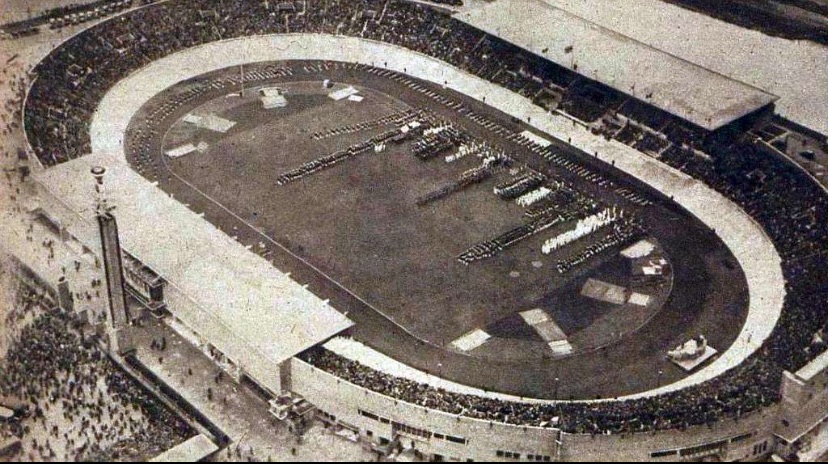
The Amsterdam Olympic stadium has been restored in its original glory. You can still visit today!
A modern stage
Societal roles were shifting in the early 1900s in Europe. Women were visible in ways that would have seemed unlikely only a decade earlier. They voted in elections in many countries and stepped into offices and classrooms that had long been reserved for men. The public mood was mixed. Dutch newspapers in the twenties often welcomed women’s growing interest in sport. Yet they warned that demanding events or ambition could disturb what they saw as the natural balance between men and women. Progress arrived, but it arrived with hesitation.
Sport moved even slower. Before 1925 women were welcome in swimming and tennis because those sports looked polite enough. Anything more physical was considered improper. Running, throwing and jumping were described as activities that did not suit the female body. Medical experts were invited to repeat the same message. They insisted that hard effort might damage a woman’s health. These ideas shaped the rules and the rules shaped who was allowed to compete.
Alice Milliat was a French athlete who understood early on that women were being held back in sport. She had competed in rowing and saw how male officials controlled every decision in international athletics. When the International Olympic Committee kept insisting that track and field was too demanding for women, Milliat chose not to wait for permission. In 1921 she founded the Fédération Sportive Féminine Internationale, an international body run entirely by women. Under her leadership the FSFI organised the Women’s Olympiad and later the Women’s World Games. These events drew thousands of spectators and proved that women could sprint, jump and throw with the same competitive quality as men. Research from the LA84 Foundation and historians such as Jean Williams shows how these crowds embarrassed the IOC and the International Amateur Athletic Federation. Milliat did not win her case by arguing. She won it by showing what women could do in full view of the world.
That growing pressure shaped the negotiations that led to the 1928 Amsterdam Olympics. For years the FSFI, the IAAF and the IOC met to discuss the future of women in athletics. The disagreement centered on two points. Milliat wanted full participation of women on the Olympic programme. The IOC resisted this but became increasingly worried that the FSFI was using the word Olympics for its own events.Academic work by Krieger and primary documents analyzed by the LA84 Foundation confirm that a compromise eventually took shape. The FSFI agreed to stop using the Olympic name and in return women were admitted to five track and field events in Amsterdam. On paper it was a limited step yet in the stadium it felt larger. Female sprinters in their lanes. High jumpers set their markers. Discus throwers waited for the call of the official. Their presence turned a small concession into a visible moment of change.
New rituals
Introducing women to athletics was not the only first that reached the stadium that summer. High above the new stands a tall brick tower carried a bowl in which a permanent flame burned through the Games. It was the first time in the modern Olympics that a symbolic fire was kept alight for the full duration of the event. Placed on top of the Marathon Tower beside the Amsterdam Olympic Stadium. Contemporary accounts and later architectural histories agree that architect Jan Wils designed the tower so the fire would be visible from far across the city and so it would mark the location of the Games in the urban landscape. The tower rose more than forty meters above the forecourt and the flame was lit by an employee of the Amsterdam electricity board, turning a practical gesture into a new ritual of the Olympics.

That same opening ceremony fixed another part of the Olympics. When the teams marched into the stadium the Greek delegation walked in first and the Dutch hosts entered last, with the other nations arranged in the Dutch alphabetical order between them. Official summaries of the 1928 Amsterdam Olympics and later Olympic histories note that this was the first time the parade followed the pattern Greece first and host nation last and that this sequence has remained the standard ever since. For spectators in the stands the new order gave a clear story to the procession, linking the ancient origins of the Games to the city that now hosted them and presenting Amsterdam as the latest stage in a growing global tradition
Shaped by the games
Taken together the stadium, the tower and the new rituals changed more than the view inside the arena. They altered how a corner of Amsterdam looked and worked during those weeks. The Olympic Stadium was built in red brick in the Amsterdam School style on newly raised ground in the south of the city, with extensive earthworks and foundations prepared specifically for the Games. Architectural studies describe how Jan Wils organized the complex as a compact cluster around the arena with the Marathon Tower set slightly apart on the forecourt so that it broke the low roofline and acted as a vertical marker over the surrounding neighborhood. Inside the tower balconies for horn blowers and loudspeakers from Philips allowed organizers to project announcements and results across the Olympic area, turning the site into a carefully managed pocket of the city where sound movement and sightlines were all choreographed around sport.
Beyond the stadium itself the city folded the Games into its ordinary streets and waterways. Almost three thousand athletes were not placed in a single purpose built village but housed wherever there was space in Amsterdam, from schools and hotels to boarding houses, private homes and ships moored in the harbor. That choice made the existing city the real Olympic village and spread the daily routines of training, dining and sleeping across different districts. A later analysis of international press coverage quotes reports from the time that describe Amsterdam during the Games as serious, energetic and modern, stressing that its residents saw themselves as fully abreast of the times rather than as inhabitants of a picturesque canal town. Cultural essays on the legacy of 1928 point out that these weeks helped to project an image of Amsterdam as an organized and contemporary European city whose new stadium and tower were part of a wider story of trade finance and architecture rather than isolated sports monuments.
Moving through a modern city
Nowhere is the mix of spectacle and practicality clearer than in the way the organizers dealt with traffic and parking. The stadium complex itself included space for around two thousand bicycles and more than three thousand cars, an unusually large provision for a city that still moved mostly on foot and by tram. Faced with an expected influx of motorists from across Europe, municipal planners created new parking sites specifically for the Games and introduced a simple new road sign to guide visitors, a white letter P on a blue background. The official report of the 1928 Amsterdam Olympics records that during thirty seven days of competition these car parks handled more than twenty six thousand vehicles, an average of about seven hundred a day, while later Olympic documentation notes that the P sign went on to become the standard international symbol for parking. In that small blue square you can still see how a few weeks of Olympic logistics left a permanent mark on everyday movement far beyond the roads that led to the Olympic Stadium.

The Amsterdam Olympics showed how change often settles in quietly before it becomes part of a shared memory. The Games introduced new rituals and new forms that felt natural even as they reshaped the identity of the event. The Olympic flame burned above the stadium for the first time and the parade followed an order that connected ancient origins to a modern host. These moments echoed the atmosphere described in this story. A sense that the 1928 Amsterdam Olympics stood at the edge of a new era. They signaled that the Games could look forward without losing sight of what had come before.
That same balance shaped the city around the stadium. Amsterdam expanded its southern districts organized new flows of people and turned everyday infrastructure into lasting markers of the event. Athletes lived across the city and the familiar blue parking sign appeared as a simple solution that would travel far beyond Amsterdam. They showed how a city and an event can grow together and how a moment that feels ordinary at the time can become a lasting part of the Olympic story.